Naked Juice and Odwalla: Pepsi and Coke

Naked Juice & Odwalla

The Food Co-op recently introduced Naked Juice after a screaming demand from the public. The on-campus café at the University carries Naked Juice, purportedly sold at $5 a bottle! So, the food co-op now carries the juice at a skinny $3.14 for 15.2 fluid ounces.

I haven’t tried the Naked Juice, and I’m really not tempted to – mostly because they are owned by PepsiCo Products. I’m trying to vote with my food dollars – I don’t really want to give my money to the company that manufactures Doritos, Frito-Lay, Quaker Oats, and Mountain Dew… not to mention who until recently owned Kentucky Fried Chicken (gulp!). Kentucky Fried Chicken (see their website here) is now a division of Yum! Foods (as are Taco Bell and Pizza Hut).

In 1991, PepsiCo partnered with a company in Burma in order to distribute their products there. Turns out, this company was partnered with the Burmese military, allegedly responsible for some of the worst human rights violations in the world. They did eventually break their ties with the company in 1997, but not until after years of protest and boycotting. Even the Coca-Cola company stopped doing business with the military in Burma before PepsiCo.

Speaking of Coca-Cola, when I was in Washington, D.C. earlier this year I purchased an Odwalla juice in one of the senate buildings. To my disgust, it was one of the only non-fried/non-meat items in the cafeteria. I later found out that Naked Juice’s counter-part was owned by PepsiCo’s counter-part. Coca-Cola acquired Odwalla in 2002 – they paid a whopping $180 million for the “healthy juice.” (Here’s an interesting article on Odwalla and Corporate Social Responsibility… ).

Why keep away from Coca-Cola? Coca-Cola is the largest manufacturer and distributor of nonalcoholic beverage concentrates in the world. Technically, Coca-Cola only manufactures their concentrated sugar syrup, which is then sold to franchises. They supply to Nestea (joined with Nestlé), they have a huge foot in the bottled water industry (see: 5 Reasons Not to Drink Bottled Water), and they have been strongly criticized for their labor practices.

Sure, Coca-Cola and Pepsi have both made some nice charitable donations. But any giant corporation has to do that to keep their public image (and keep their tax write-offs).

It’s hard to support family-owned companies. Chances are most things in an avid food co-op shopper’s pantry are owned by Nestlé, Coca-Cola, PepsiCo, or Cargill. Another example- Stacy’s Pita Chips: Frito-Lay: Coca-Cola.
Wild Wood Organics

Wild Wood Soy Yogurt

Recently I mentioned WholeSoy yogurt, just a couple days before the company had a number of products recalled because they may have contained dairy.

I have more contempt for the dairy industry than I do for the beef industy, which makes me shudder every time I see a soy product marketed as “Vegan” that is owned by the dairy industry or manufactured alongside a dairy industry product.

Given vegan standards (and taste too!), Wild Wood Organics wins the coin flip for soy yogurt. Their website boasts:

Wildwood Soyogurt is NOT produced on equipment shared with dairy. We own and operate our own non-dairy facility. We are the only brand of Soy Yogurt that is not manufactured using shared dairy equipment.

The company itself is fairly interesting. It’s a joint company (Pulmuone and Wildwood) with roots stemming both from a family farm in Iowa and a farming cooperative in Korea. The cooperative in Korea (Pulmuone) was started in 1955, and entered the US in 1991. Since 1978, Wildwood has been creating organic/natural vegetarian products – apparently their fame started with the BRT sandwich (Brown Rice & Tofu). Their soybeans mostly come from the midwest, though the company is known best on the west coast. The two companies joined in 2004. (Visit Wild Wood’s website and Pulmuone’s website).

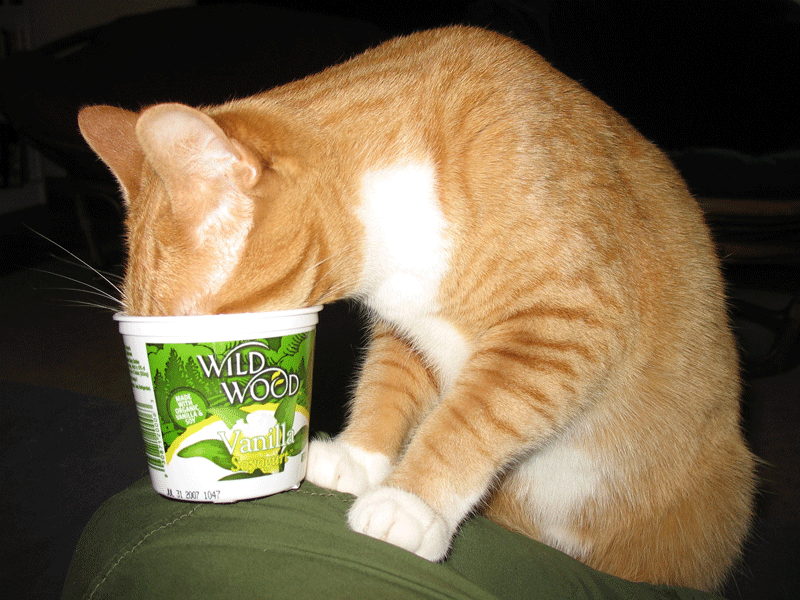
As you can see, Niko likes the yogurt as well. I’ve been special ordering it weekly from the food co-op, and between Chris, Niko, Nigel, Puck, and myelf it’s pretty easy to go through a case of 12 in a week. Nice to finally have some breakfast foods around the house. We all agree that Vanilla is the best – though Niko is fond of blueberry as well.

I’m now considering ordering a case of plain (unsweetened) to see if I can use it as a culture to make my own soy yogurt (with homemade soymilk from local soybeans, of course). When time permits…

Seitan

We’ve been buying a lot of mock duck recently. For a while we were making food for Niko with it (she can’t get enough), but then it sort of became a staple. It’s simlar to – but not exactly the same as – seitan, which is incredibly easy to make.

The canned stuff is imported from Taiwan – I don’t know too much about the brand (Companion). Our Food Co-op sells it for $2.79/can (10 oz.). White Wave makes some packaged seitan. But, beware: White Wave is a subsidary of Dean Foods, a distributor of Horizon Organic and Hershey’s!

Rather than spend $2.79 for a 10-ounce a can (or supporting Corporate America), you can make a couple of pounds of seitan for about $5. If you have a food processor, preparation time is less than 2 minutes.

Seitan

Combine in a food processor:

  • 2 cups wheat gluten
  • 2 Tbsp. nutritional yeast (optional)
  • 2 tsp. salt
  • (optional) spices and flavorings to taste. Cumin, coriander, garlic powder, onion powder, sage, rosemary, thyme, and chili powder are some ideas.

Blend quickly until everything is mixed. Then mix together:

  • 1 cup water
  • 1/2 cup soy sauce
  • 1/4 cup oil

Have another cup of water on hand.

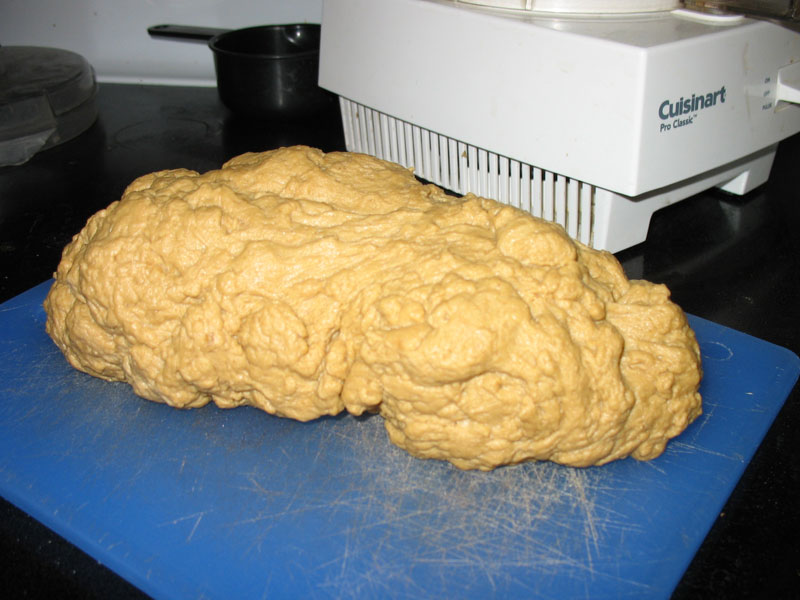
Start the food processor and slowly pour in the mixed liquid. The gluten should form a blob… you may need to add a bit more water, but the ball of gluten should completely absorb the liquid. It should look a bit moist, but should not be juicy. Process for 1 – 2 minutes. (You food processor will wobble like crazy).

Seitan Loaf

Take out the loaf and shape it into a log. It should be really stretchy and tough to tear apart. Let it sit for about 15 minutes.

Uncooked Seitan

Cut seitan into manageable pieces. You’ll need a sharp serated knife (a steak knife works well). It’s a bit hard to cut, so I usually cut it into about 8 large chunks.

Boiled Seitan

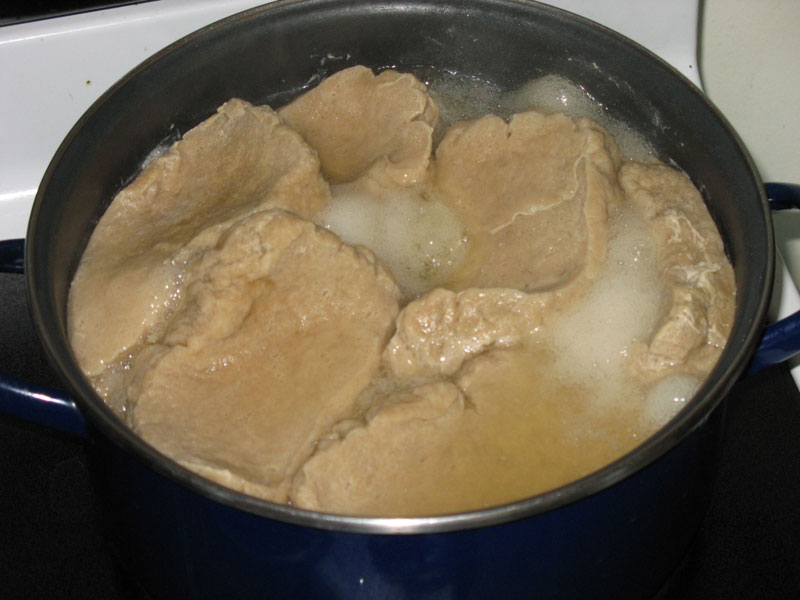
Bring a large pot of water to a boil. Drop in the seitan pieces (one at a time so they don’t stick together), bring back to a boil, reduce heat and simmer for about 10 minutes. Drain (reserve the liquid – it makes a good stock), cool, and cut into desired shapes.

If the seitan cooked through (depending on how thick your slices are), you can eat them as-is. It’s much better after it’s been fried up with some onions.

WholeSoy Raspberry Yogurt

Niko likes yogurt

Meet Niko, our year-old orange cat. Niko likes to eat just about anything.

To kick off her online food review column, Niko helped me finish off a container of WholeSoy & Co. Raspberry Soy Yogurt. I was surprised that she didn’t mind the berry flavor… but then again, she helped me eat some rhubarb pie earlier in the day.

Star rating: 4 out of 5. Generally anything creamy is high on the list.

Kombucha for All!

Puck loves Kombucha

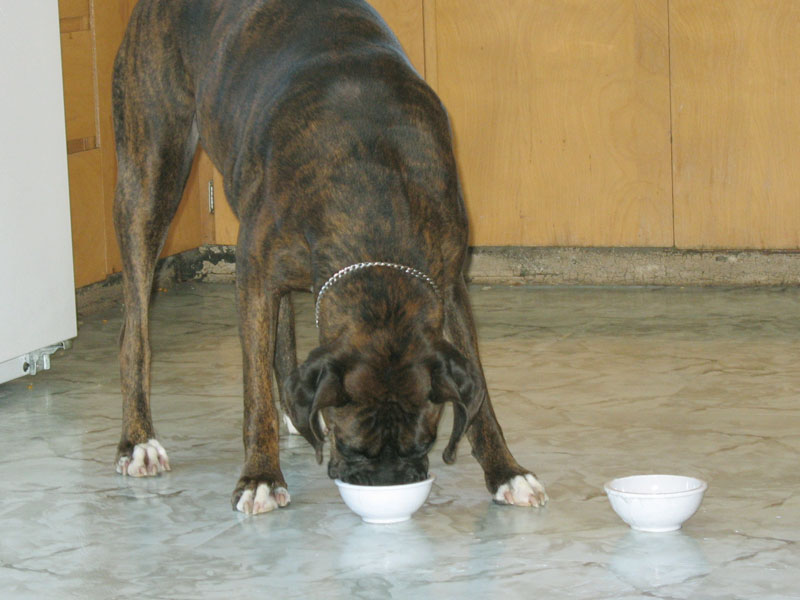
Believe it or not, both Puck and Nigel are huge kombucha fans. A couple weeks ago when Puck was having some problems with his food, I gave him some kombucha. It’s full of probiotics, and is supposed to support the digestive system. I guess Chris started giving it to the dogs regularly when I was in D.C., and now they actually beg for it. There could be worse things, right?

Speaking of Puck and his digestion, I won’t go into the details but we noticed a huge difference – immediately – when we ran out of Nature’s Recipe dog food and started cooking them meals. I picked up some more Nature’s Recipe food when I was in the cities, and he immediately lapsed back into the digestive problems after eating only a small amount. So the dogs are on a home-cooked diet now (following recipes from Vegetarian Dogs), and seem to be in better spirits and health.

VegDog, VegCat.

niko-puck.jpg

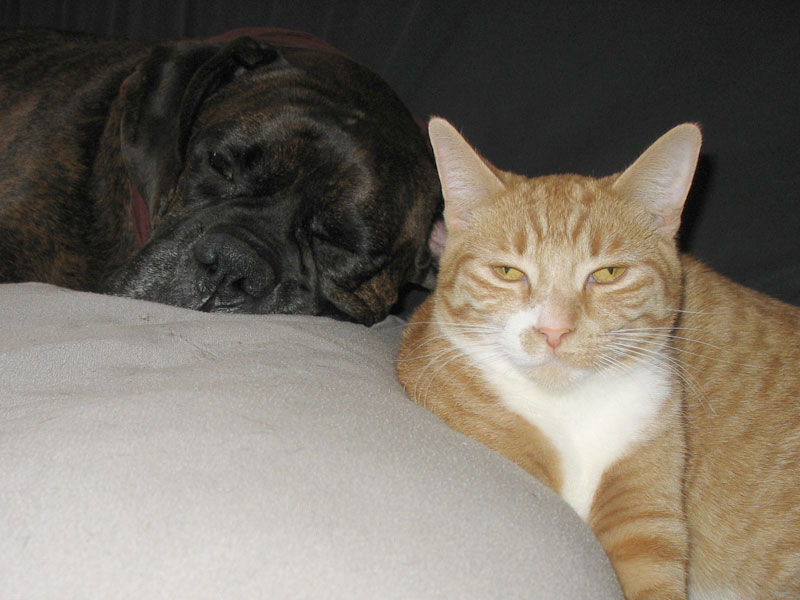
It’s hard to take a picture of Niko and Puck together because of their difference in color. But if you look from the right angle, it’s a pretty cute picture.

Chris bought some Evolution Vegan Cat Food from vegancats.com a couple of weeks ago, and Niko loves it like nothing else. We got two cans (complete nutrition for daily feeding), VegeCat Supplement (for adding to home-cooked meals, also providing complete nutrition for daily feeding), and some yeast for flavoring.

Niko’s been eating about a half-and-half diet – Evolution Canned Food/Pet Promise Dry Food or Homemade Meal/Pet Promise Dry Food for the past week or so. She seems to be doing very well, but we have a lot of Pet Promise food left, so we’re waiting to finish that up.

After reading Obligate Carnivore by Jed Gillen, we decided to try Niko on a partially vegan diet. Of course, we need to make sure she stays healthy, but the Evolution food and supplements contain the exact same synthesized minerals found in dead-animal cat food. Commercial cat food needs to contain synthetic nutrients, as the rendering/processing gets rid of nutrients found naturally in animal flesh.

The thought of feeding our cat other dead cats, dead dogs, roadkill, and parts of animals “unsuitable for human consumption” is quite unbearable. So, it’s either this route or home-cooked meaty meals (something that my kosher kitchen is not ready to be sacrificed to).

Niko’s a female, which makes this diet very possible. Male cats, on the other hand, can develop serious pH inbalances from food that isn’t formulated correctly. The company recommends frequent urine pH tests if starting a male cat on a vegan diet. However, they recommend that “all female cats immediately be placed on a vegan diet.”

I’m sure we’ll have a thorough vet visit in the future, but I am hopeful for this new diet. Many cat and dog refugees/sanctuaries feed their rescued cats and dogs strictly vegan diets, mostly because the people who run the sanctuary are vegan.

Think I’m nuts? I’ve got two vegan dogs. (Search the Internet for “oldest living dog” – seriously… do it!). Today, a lot of people are moving their cats to vegan diets – here’s an article from a magazine we subscribe to: Clear Your Conscience, Cat Lover (Satya).

Some more links:

… the API does not recommend feeding cats a vegan diet, but their reasoning is because the long-term implications of synthetic nutrients are unknown. A recent study by vegetariancats.com confirms that comparatively, long-term vegetarian feeding of cats does not lead to nutrient deficiency. Many personal testamonials also support vegan cat diets.